
Property investment ROI can be a long-term wealth-building strategy, but before investing, it’s important to understand whether the property makes financial sense.
One useful way to evaluate a property investment is ROI — Return on Investment.
ROI helps you compare the money you invest with the potential return generated by the property.
What Is Property ROI?
Property ROI measures how much return you may earn compared with the amount you have invested.
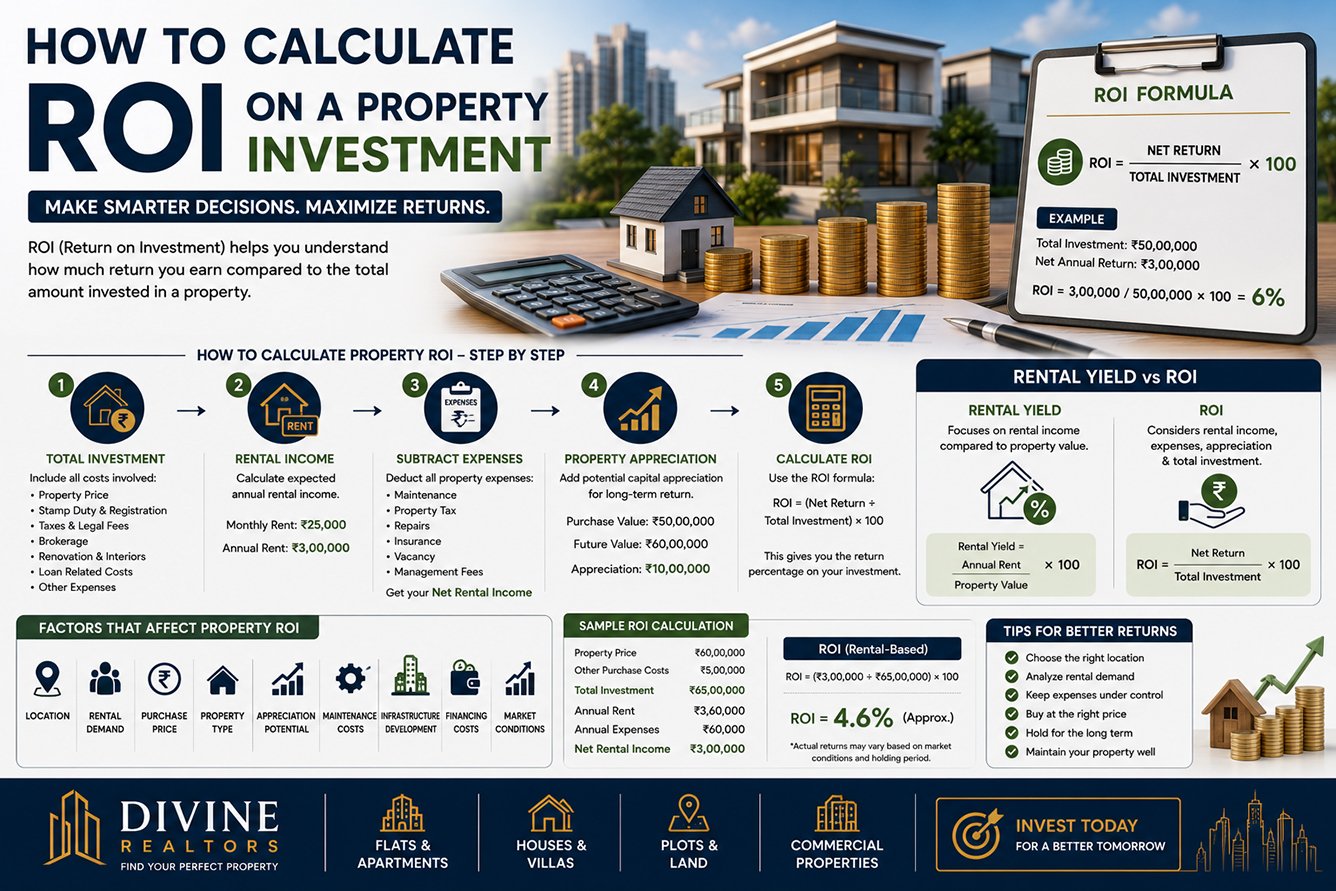
A simple ROI formula is:
ROI = (Net Return ÷ Total Investment) × 100
For example, if your total investment is ₹50 lakh and your net annual return is ₹3 lakh:
ROI = (₹3 lakh ÷ ₹50 lakh) × 100 = 6%
This is a simplified example. Actual property returns can involve several additional costs and factors.
1. Calculate the Total Investment
Don’t consider only the property’s purchase price.
Your total investment may include:
- Property purchase price
- Stamp duty and registration
- Taxes
- Brokerage
- Legal fees
- Renovation and interiors
- Loan-related costs
- Other applicable expenses
For example:
Property price: ₹50 lakh
Other purchase costs: ₹5 lakh
Total investment: ₹55 lakh
This gives you a more realistic basis for calculating returns.
2. Calculate Rental Income
If you plan to rent the property, determine the expected annual rental income.
For example:
Monthly rent: ₹25,000
Annual rent: ₹3,00,000
However, don’t assume the property will remain occupied throughout the year. Vacancy periods and tenant-related costs can affect actual income.
3. Subtract Property Expenses
Your actual rental return isn’t simply the rent you receive.
Consider applicable expenses such as:
- Maintenance
- Property taxes
- Repairs
- Insurance
- Property management
- Vacancy periods
- Other ownership costs
After subtracting these expenses, you get a more realistic net rental income.
4. Consider Property Appreciation
Rental income isn’t the only potential source of return.
If the property increases in value over time, the appreciation can contribute to your overall investment return.
For example:
Purchase value: ₹50 lakh
Future value: ₹60 lakh
Capital appreciation: ₹10 lakh
However, property prices can also remain flat or decline. Appreciation should never be treated as guaranteed.
5. Don’t Forget the Holding Period
ROI should be considered in relation to the amount of time you hold the property.
A property that increases in value by ₹10 lakh over one year is very different from one that increases by ₹10 lakh over ten years.
For long-term investments, also consider how inflation, maintenance and financing costs affect the real return.
Rental Yield vs ROI
These terms are related but not identical.
Rental Yield
Rental yield focuses primarily on rental income compared with the property’s value.
A simplified formula is:
Rental Yield = (Annual Rent ÷ Property Value) × 100
ROI
ROI provides a broader view and can consider rental income, expenses, appreciation and the overall investment.
For property investors, looking at both rental yield and overall ROI can provide a better understanding of the investment.
What Factors Can Affect Property ROI?
Several factors can influence your returns:
- Location
- Purchase price
- Property type
- Rental demand
- Property appreciation
- Vacancy
- Maintenance costs
- Financing costs
- Infrastructure development
- Economic conditions
This is why two properties with similar prices can produce very different investment results.
Example of a Simple Property ROI Calculation
Suppose you purchase a property for:
Property price: ₹60 lakh
Purchase-related costs: ₹5 lakh
Total investment: ₹65 lakh
Suppose the property generates:
Annual rent: ₹3.6 lakh
Annual expenses: ₹60,000
Net rental income: ₹3 lakh
A simplified rental-based ROI would be:
ROI = (₹3 lakh ÷ ₹65 lakh) × 100 = approximately 4.6%
If the property’s value also increases over time, your overall return could be higher. But actual returns depend on market performance and the complete costs involved.
Is a Higher ROI Always Better?
Not necessarily.
A property with a higher potential return may also involve higher risk, greater vacancy potential or more management requirements.
When comparing properties, consider:
Return + Risk + Location + Quality + Liquidity + Long-Term Potential
The goal should be to find an investment that fits your overall financial strategy.
Final Thoughts
Calculating property ROI can help you make a more informed investment decision.
Before purchasing, look beyond the advertised price and consider rental income, expenses, appreciation potential, financing costs and holding period.
At Divine Realtors, we help buyers explore residential flats and apartments, independent houses and villas, plots and land, and commercial properties.
Looking for a property investment opportunity? Explore your options with Divine Realtors and choose a property that aligns with your long-term goals.
Frequently Asked Questions
How is property ROI calculated?
A simplified formula is ROI = (Net Return ÷ Total Investment) × 100. For a complete analysis, investors should also consider expenses, financing and potential appreciation.
What is a good ROI for a property?
There is no universal ROI that is considered good. It depends on the property type, location, risk, investment period and alternative investment opportunities.
Is rental yield the same as property investment ROI?
No. Rental yield focuses mainly on rental income, while ROI can consider the broader return from rental income, expenses and property appreciation.
Does property appreciation count in ROI?
Yes, potential capital appreciation can contribute to overall investment returns. However, future appreciation is not guaranteed.